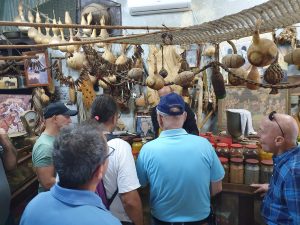


Walid Kashash, born in Acre, has managed to decorate most of the Old City and beyond with his art, which he creates entirely from items discarded on the street. Kashash has a gallery with a well dating back to the Turkish era, from which another well descends. Next to his gallery is an alley filled with examples of his work.
Kashash has been painting and sculpting since the age of 18. He is now over 60, and his son Jassan is following in his footsteps and taking photographs. Kashash's gallery also displays his son's photographs.

The Knights' Halls are a complex of halls built by the Hospitallers. In Crusader Acre 1,000 years ago, many people lived there, including the Hospitaller Order. For about 40 years, excavations, restoration, and preservation work were carried out until the site was opened to visitors.
Today, you can visit the various rooms, look at history, the various items that have been discovered, tunnels, jewelry, meaningful wall carvings, and try to see the full picture—what Acre looked like 1,000 years ago. You can wander around the Knights' Halls for hours and never really see everything.
Every year during Sukkot, the Acre Festival is celebrated here, which is a beautiful festival with alternative theaters and a variety of performances.

Whenever someone complains about a drainage problem in Acre, there is always an interesting story behind it. That's how it is when you have a 400-year-old city built on the ruins of an even older city – one that is 1,000 years old.
And so it was a decade ago: a man complained about a blockage in his home, and when they came to check the source of the problem, they discovered an opening leading to a huge space. When they began digging, they discovered this tunnel.
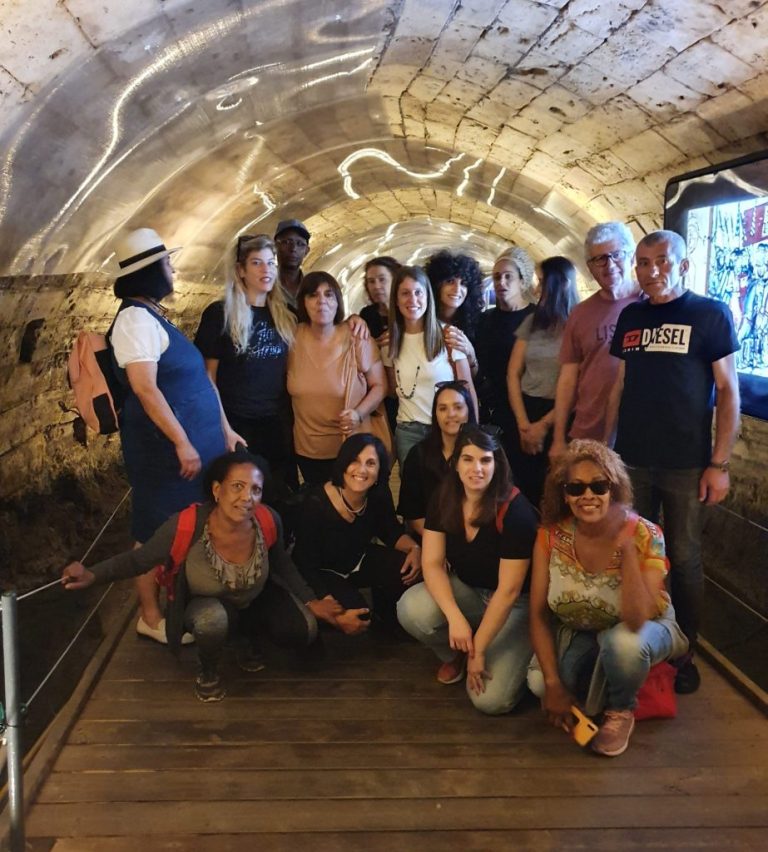
The Templer Tunnel was opened to visitors just a few years ago, allowing you to walk from the center of the Old City to the sea! I've ruined the surprise for you, but there's nothing more beautiful and surprising than emerging from the darkness and depths of the earth to the beautiful sea, the waves, the seagulls, and the sun.
What was the tunnel used for? And why did it not appear on ancient maps? Some believe that the tunnel was kept secret in order to transport goods through it without paying customs duties and without passing through city officials.
It is not without reason that it was named the Templar Tunnel. The Templars were the wealthiest of the Crusader orders, and their physical location in the Old City of Acre was indeed where the tunnel originated. This certainly explains a few things about the Templars' wealth and the tunnel's location.

The Turkish bath in Acre tells the story of a grandfather and son, each of whom, in his own time, was responsible for managing and maintaining a classic Turkish bath in the Old City. Through their story, you can learn about the entire history of Acre, from the Crusaders, through the Mamluks, Dahir al-Umar, Al-Jazzar, Napoleon, and more, up to the present day.
During the tour, visitors walk through the rooms of the hammam and learn about the function of each room during the Ottoman period, when there were many hammams like this one.
The story can be heard in many different languages, and the most beautiful thing is to see how they managed to take an old, inactive hammam and turn it into a lively place full of history and stories, visited by many people every day.

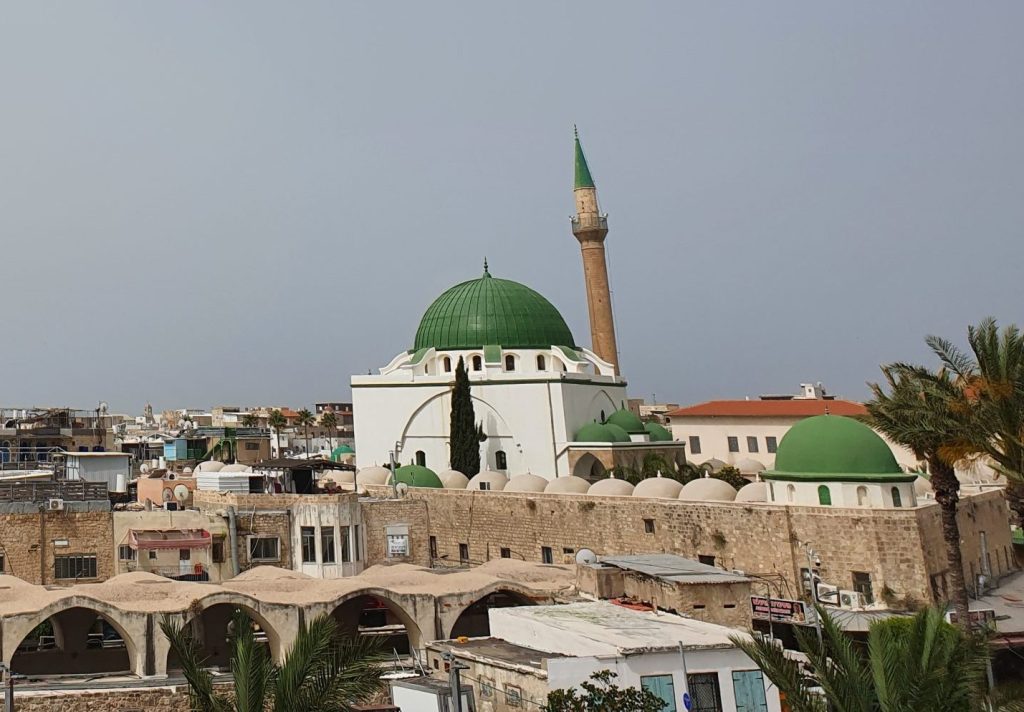
On every rooftop in the Old City, we can see the unique buildings of this city, which is home to large and famous mosques. The most famous of these is the Al-Jazzar Mosque.
Between the rounded roofs of the mosques, you can see the tall towers of ancient churches, which also tell a special story about this unique city.

There is so much more to see and taste in the Old City, but it is important to remember that there are the Bahá'í Gardens at the northern entrance to the city.
The Bahá'í Gardens in Acre are the most important and sacred site for all Bahá'ís around the world. The gardens in Haifa come second to those in Acre. Bahá'u'lláh, the founder of the religion and the actual author of the Bahá'í religious texts, was exiled to Acre. One of his places of detention was here in the Bahá'í Gardens, so when he passed away, it was decided that a garden would be established in his memory here, in the house where he lived, with his tomb, of course.
The Bahá'í religion was founded in 1844 in Persia by Ali Muhammad Shirazi, who called himself the Báb, the gateway to a new and better world. The principles of this monotheistic religion are that everyone is one and everyone is different, and that there is equality among all peoples and all species.